Basic Concepts of Nutrition
According to the World Health Organisation (WHO) – Nutrition is the intake of food, considered in relation to the body’s dietary needs.
According to the World Health Organisation (WHO) – Nutrition is the intake of food, considered in relation to the body’s dietary needs.
Many food items in India have some special values. These food items not only provide us many nutrients, they provide us many phytochemicals that protect our bodies from many external factors as well.
Biotechnology in Agriculture: Applications, Techniques, and Benefits The scientific knowledge which is applied in practical ways in industry for the…
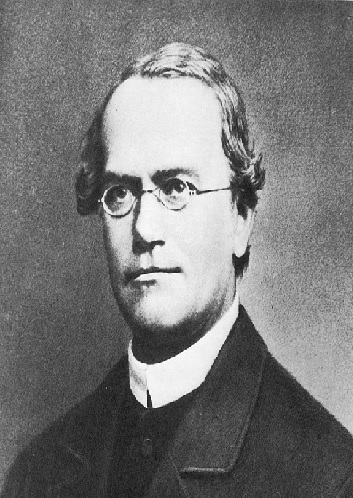
On the basis of his experiments of hybridization Mendel proposed following rules of heredity-1. Law of dominance, 2. Law of iseggregation and , 3.Law of Independent Assortment.
Living organisms capable of synthesizing food on their own are called as plants. They contain chlorophyll, the green magnesium compound which helps in trapping the energy from sun. This energy runs the process of photosynthesis through which glucose is basically synthesized in leaves and green stems on combining together the atmospheric carbon dioxide and water.
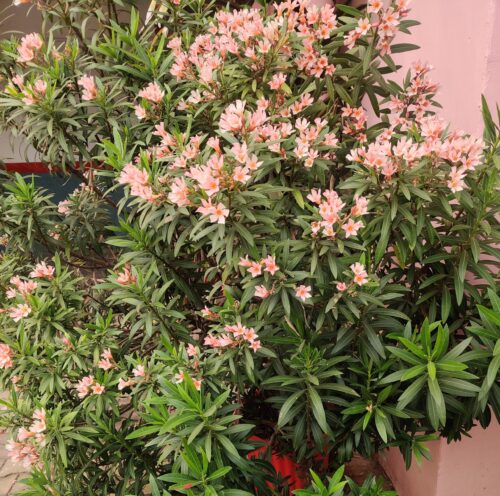
Nerium oleander is commonly known as Oleander or Nerium. It is a shrub cultivated in sub-tropical and temperate areas as ornamental or landscaping plant. In India it is currently grown along highways and gardens.
Ever since the earth was inhabited, humans and other life forms have depended on things that exist freely in nature to survive. These things include water (seas and fresh water), land, soils, rocks, forests (vegetation), animals (including fish), fossil fuels and minerals. They are called Natural Resources and are the basis of life on earth.
A Pesticide is a chemical substance of natural or synthetic origin. It is applied in different forms to kill pests. Pests are living organisms that tend to harm humans, their crops and animals or have a tendency to disturb general household and living conditions. Some organisms can also be applied to kill pests. These organisms are called as biopesticides. On the other hand, pesticides that are synthesized in factories are called as synthetic pesticides.
A substance, factor, change, living being or a system that quantifies and simplifies phenomena and helps in understanding complex realities,…
The biosphere is itself a vast ecosystem which incorporates all the small ecosystems. But, the biosphere may have different types of physical conditions, communities of plants and animals, and climatic conditions in its different zones.
I did not know about the Valentine’s Day or the Valentine’s Week even till I was married. I don’t know either when I knew about it.
Determining male or female form of living organism through sexual reproduction is called as sex determination. Sex determination on a large scale is of two types- environmental, genetic and chromosome based.