
Effect of climate change on development of plant roots
Roots of plants too, respond to the changes in climate.

Roots of plants too, respond to the changes in climate.
Abrupt changes in environment often do not give time to an organism to get ready and to face the challenges. As such the organism can survive only when it has sufficient abilities to tolerate these changes.
Living beings interact among themselves in the same species, with the members of the other species, and with the components of the abiotic environment in an ecosystem. Interaction between the members of the same species is called as Intraspecific whereas the interaction among individuals of different species is called as Interspecific.
The processes of development through years have spurred on unplanned urbanization, extensive industrialization followed by different types of pollutions, construction of a series of mega dams, and large-scale application of Agro-chemicals. In the process, different parts of the world have started facing ecological crises.
Our environment today is facing a number of problems. All those problems are causing dangers to take shape against the existence of the whole biosphere of this planet. But who is behind all those problems? The answer is – M A N.
Environment may be defined as ‘Complete range of various sets of external conditions comprising- physical, biological, and for human beings- cultural, economic and political conditions; in which human beings and other life forms exist in continuous interactions among themselves.
Human activities have never been friendly to environment. The remains of Mohenjo-Daro and Harappa signify that the civilization ended due to desertification which might had been caused by large scale deforestation. Still today impacts of such human activities have started appearing. Hence it is essential that we manage our natural resources properly.
Environment and its components like wildlife and Natural Resources constitute the vital life support system for all life on this planet. The protection of these through the cumulative efforts of the world community started across globe due to the persistent efforts of the United Nations through its Environmental Programme (UNEP).
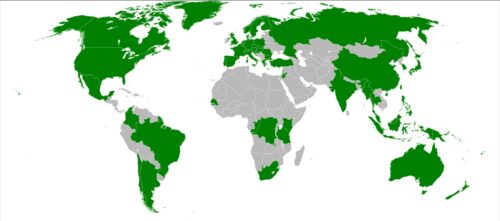
The tragedies in the environment stimulated the world nations the recognition of which first appeared in the shape of the United Nations Conference on Human Environment for the preservation and enhancement of its quality, at Stockholm from June 6 to June 16 in the year 1972. The delegates from 114 nations attended the conference and signed the Stockholm Declaration.
A number of non-governmental organisations (NGOs) or non-governmental agencies have been playing their important roles in spreading Environmental Awareness across the globe and in developing policies for the protection of environment and sustainable development.
Dignity of labour means – all jobs are equal and no job should be considered as big or small.