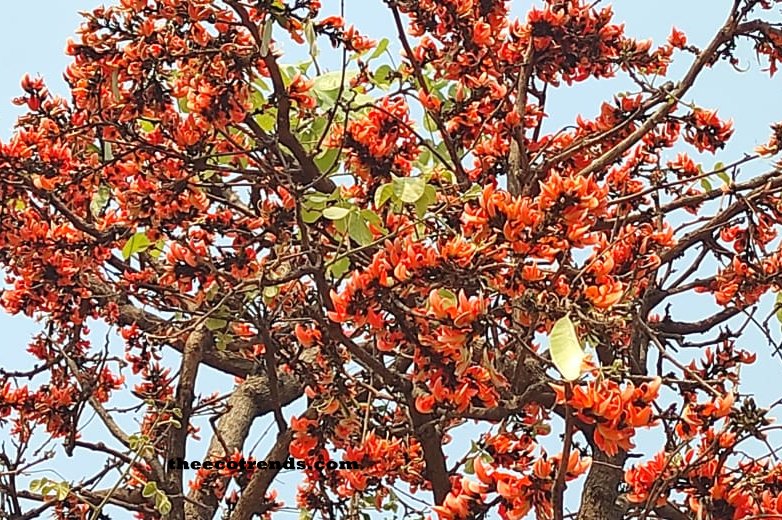
Palash-The State Flower of Jharkhand in India
Palash or Butea monosperma is an important tree of taxonomic family Fabaceae which is native to tropical and sub-tropical India. It is also found in Pakistan, Bangladesh, Nepal, and Srilanka etc.
Living beings have many processes in common. Among all the common processes there is one very interesting and wonderful process…
Most of the animals have a network of very fine filamentous or threadlike structures which exchanges information. These structures are called as nerves.
We have damaged ecosystems in the name of development. Wildlife too is facing danger. Our activities have impacted in such ways that animal population has fallen into a serious zone of danger.
Ecosystems can be categorised into two broad categories: natural and artificial. Natural Ecosystems are those ecosystems that operate by themselves under natural conditions. These ecosystems are further categorized as Terrestrial and Aquatic Ecosystems. Terrestrial ecosystems relate to lands, whereas Aquatic ecosystems relate to fresh or marine water. Freshwater ecosystems may be Lotic or Lentic. Lotic are running water ecosystems like springs, streams or rivers, whereas Lentic Fresh Water Ecosystems may be found in standing waters of lakes, ponds, pools, puddles, ditches, swamps, etc. Marine Ecosystems are found in marine waters of salt lakes, seas, oceans and estuaries. Artificial Ecosystems are man-engineered ecosystems like crop fields, artificial ponds and lakes, aquaria, fish ponds, and abandoned mines reclaimed as lakes or water bodies for recreation.
World Water Week Stockholm is celebrated every year from 23 to 28 Aug. every year. Due to pandemic covid-19 it is taking place from 24 to 28 Aug. this year with a theme- World Water Week at Home.
There are various uses of Solar Energy. Farmers in Traditional Farming Communities used to solarise fields by living them empty after a deep ploughing during summers. It killed insects and pests. Human skin synthesizes vitamin-D when exposed to sunlight for short durations. Mothers used to make their babies sleep in the sun after oiling their bodies during winters in order to keep them healthy and strong.
Images of a number of vegetables start sliding one by one just as a slide show on the screen of the mind as we enter into the winter session of the yearly cycle. These vegetables are very important to us not alone for their taste value but for their medicinal and health value as well. Here is an introduction of two of these vegetables.
Tulsi or the Holi Basil is taxonomically called as Ocimum tenuiflorum. It is an aromatic and perennial plant which belongs to the taxonomic family Lamiaceae
Due to less paying agriculture farmers migrated to cities. The volume of migration was seen during the lock down period when farmers left cites for remigation. Remigrated farmers can be checked to their fields by improving pricing and free maket system to farmers.
A population is a group of individuals (all members of a single species) who live together in the same habitat and are likely to interbreed. Each population has a unique physical distribution in time and space. It may contain individuals of different ages, and its size (density) is likely to change over time. It grows or shrinks according to the reproductive success of its members.
The balance of nature is maintained by its different components -living and non-living, if they remain unaltered by human beings.